
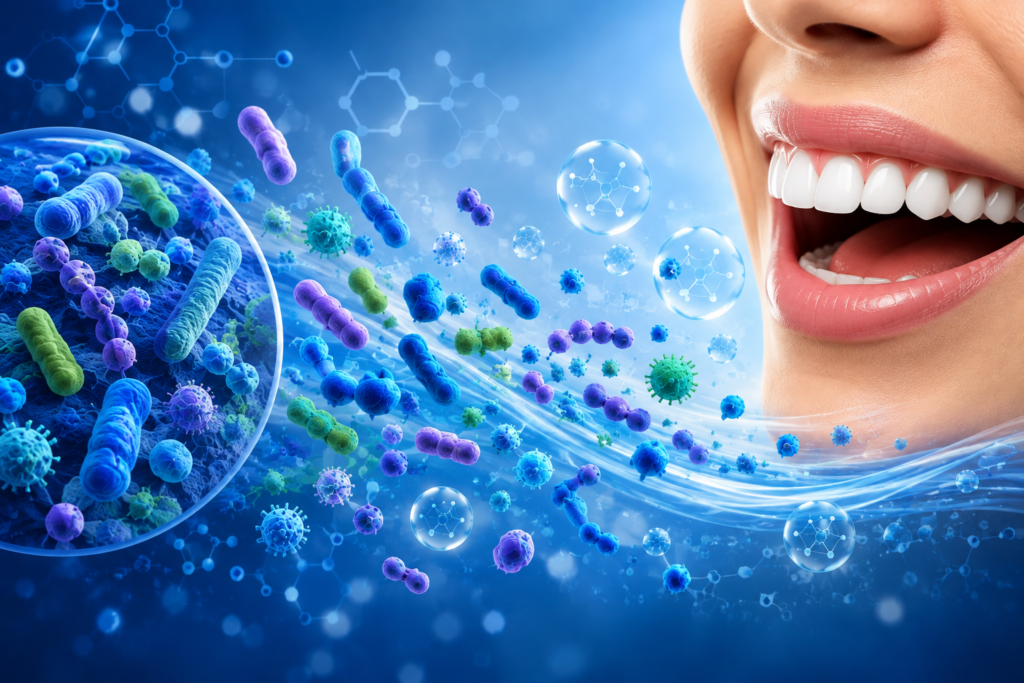
Your mouth is home to a complex community of microorganisms known as the oral microbiome. While some bacteria can contribute to oral health problems, others are part of the natural balance of a healthy mouth. Understanding this balance can help you make more informed choices about your daily oral care.
What Is the Oral Microbiome?
The oral microbiome is the community of microorganisms that naturally live in your mouth, including on your teeth, gums and tongue. These microorganisms interact with one another and with your everyday habits, making the oral microbiome an important part of the oral environment.
Why Does Balance Matter?
Daily habits such as diet and oral-care practices can influence the environment inside your mouth. Supporting a balanced oral environment is one reason people are becoming increasingly interested in the relationship between beneficial bacteria and oral health.
Where Do Oral Probiotics Fit In?
Oral probiotics are marketed for oral care, but studying mouth microbes is not the same as demonstrating a benefit from a commercial supplement. NCCIH discusses limits and differences in probiotic evidence. A product cannot be judged effective simply because it contains bacteria associated with oral-health research.
The Oral Microbiome Includes More Than Bacteria
The oral microbiome includes bacteria, fungi, viruses, and other microscopic organisms. Different parts of the mouth provide different habitats: the tongue, teeth, and gums do not all host the same community. Microorganisms are a normal part of the mouth; their presence alone does not mean an infection is developing. The NIH introduction to the oral microbiome explains why researchers study these communities.
What Can a Microbiome Finding Tell You?
Research explores how microbes interact with one another and with the body. A relationship observed in research does not, by itself, identify the cause of one person’s symptoms or prove that a commercial supplement will improve them. Laboratory findings and research on specific organisms should not be treated as a clinical test of ProDentim or ProvaDent. See NIDCR’s overview of oral microbial research.
Daily Care Still Comes First
For routine prevention, NIDCR recommends brushing twice daily with fluoride toothpaste, cleaning between teeth, limiting sugary foods and drinks, and attending dental checkups. Decay-causing bacteria can produce acid when exposed to sugars and starches. This is one reason repeated sugary snacks matter to oral health. See NIDCR guidance on tooth decay.
Probiotics, Prebiotics, and Product Claims
Probiotics contain live microorganisms; prebiotics are food components that selectively support certain microorganisms. They are not interchangeable terms. NCCIH explains that different probiotic organisms can have different effects. Evidence for one organism or formulation cannot automatically establish the benefits of another product. Read NCCIH’s explanation of probiotic usefulness and safety.
Before choosing a supplement, check the organisms and serving directions on its current label, warnings, and storage instructions. A larger printed bacteria count alone is not proof that a product is more effective. Our product reviews organize label and purchase information; they do not establish clinical effectiveness.
When to Ask a Professional
Do not delay a dental assessment because you are trying a supplement. Persistent symptoms need their own evaluation. If you are considering probiotics, discuss suitability with a healthcare professional, particularly if you have a serious illness or a weakened immune system. NCCIH notes that safety information is limited and risks can be higher in these groups.
Does “balancing bacteria” tell me what to buy?
No result in this guide identifies an ideal microbial balance for an individual. A general microbiome finding does not show that a tablet will correct the cause of symptoms. For practical prevention, follow the NIDCR oral-care guidance linked above; bring ongoing concerns to a dentist.
About This Guide
MouthSignal prepared this educational guide using the NIH resources linked above. Editorial content updated October 27, 2026. It is not individualized medical or dental advice. MouthSignal is an affiliate website and may earn a commission from purchases made through affiliate links in its product reviews, at no extra cost to you.
How to Check Supplement Information
Before reading a product review, use our checklist for oral probiotic labels, servings and costs. It does not establish that a supplement treats bad breath or changes your microbiome in a beneficial way.
Considering an oral-health supplement? Read our independent ProvaDent review for a closer look at its label and buying considerations.